Saturday, July 29, 2006
Desperation time
How could they be so desperate? Simple. Gringolandia's leading political mercenary came to Venezuela, took an exhaustive look at the situation, and hit the opposition upside the head with a very hard reality - they are hated and despised by most Venezuelans and Chavez will easily blow any of their candidates out of the water. Here is an article explaining what Dick Morris found:
Poll: The only one capable of beating Chavez is an "outsider" candidate
A little more than six months ago, a Venezuelan business group contacted the American Dick Morris (the celebrated political consultant and principle electoral strategist of the recently elected president of Mexico, Felipe Calderon) to carry out an analysis on the Venezuelan electoral panorama, with a focus on the upcoming presidential elections of December 3rd.
Morris arrived in Venezuela in February and established an alliance with the polling firm Hinterlaces (headed by Oscar Schemel), to conduct the field work and validate the results.
After a few weeks hammering out the details of the study, the pollsters hit the streets and collected data between the 7th and the 24th of June in more than 50 cities and towns throughout the country. In almost three weeks, they interviewed more than 1,200 Venezuelans enrolled in the electoral registry and who intend to vote in the upcoming elections.
Morris returned to the country last week to sign off on the results. The final report is ready, various campaign organizations have it, and the results are very clear.
First, the analysis makes it very clear that (under current conditions) none of the current candidates are capable of defeating President Chavez on December 3rd.
The second finding indicates that the president is, today, much stronger than he was in 1998 and 2000 (the two last campaigns in which he participated); that his lead has become even stronger in recent months, and that he has a very solid electoral base.
The third conclusion (resulting in part from the first two) is that the only way to defeat Chavez in the upcoming presidential elections is for there to arise a new candidate that is currently not on anyones political radar and with a very specific profile: an authentic outsider.
Clear numbers
Looking at the numbers from Hinterlaces study the strength of the president is very clear: the percentage of people intending to vote for Chavez , in the month of June, is a solid 55% (which has remained constant during the last few months).
Very far behind are the second tier candidates: the governor of Zulia, Manuel Rosales (with 7%), the Primero Justicia leader Julio Borges (with 5%) and Teodoro Petkoff (with 3%).
The analysts also pointed out that Roberto Smith is close to that group with 2% support.
But beyond that enormous difference, this question revealed something interesting: Hinterlaces included among the possible answers the option of a "new candidate" which got 17% support (more than the sum of the three leading opposition candidates).
For Morris and Schemel, this element showed the opportunity that an outsider would have to create a new electoral dynamic.
Who would be the potential voters for that new candidate? "The independents", said Schemel.
The political spectrum showed two polarized minorities and an enormous group that prefers to stay away from the extremes: 49% of those spoken to classify themselves as Ni-Ni (neither-neither), 33% chavistas (20% moderate and 13% radical) and 16% opposition (7% moderate and 9% radical).
This independent mass is reflected in the party affiliation: 62% consulted classify themselves as independents, 29% supporters of the MVR [Chavez's party - ow], and the opposition parties shows levels of support than never go above 3%.
Quantitative analysis:
How can one know that Rosales, Borges and Petkoff cannot become in the next four months, candidates who could possibly defeat Chavez?
To determine that Schemel decided to carry out 18 focus groups to complement the results of the polls and the weakness of the three candidates became clear.
In the case of Petkoff (the most rejected by those consulted, with a 52% rejection rate) his age works against him as does his relationship with past politicians. "The people say he already had his chance and he cannot win, and that he should give way to others. Also his negatives are driven by his past membership in the armed left and his being in the last cabinet of Rafael Caldera" said the analyst.
For his part, Borges (who has a 47% negative rating) looks like someone very far removed from the lower classes. "He is seen as more "opposition" than all the candidates; identified with the rich, those who have money and very far from those of humble origins", explained Schemel.
At the same time, Rosales (the best positioned with only a 39% negative rating) is percieved as "crude; without a program and without specific proposals for the country".
A curious fact is that the President has a lower negative rating than these three candidates: 26%.
Roberto Smith registers negatives similar to Chavez, but the analysts attribute that to him only being known by a little more than 40% of those interviewed.
In general, the study determined that the leadership of the opposition registers a very high level of rejection (around 83%), because the president has been successful with his message, has been successful in having the voters associate that sector with "a rich exclusive elite", and headed by "leaders of the past".

This is just such a blowout its hard to know where to begin. There isn't an opposition candidate within 40 percentage points of Chavez even though the campaign has yet to begin (Chavez is an excellent campaigner). Even their hypothetical "outsider" trails by nearly 40%. And given that Chavez is over 50% there is no way for them to overcome him unless his support were somehow to decline significantly.
It is also quite telling that in spite of a relentless media campaign against him for seven years now his negative ratings are a quite low 26%.
But to me here is the most damning statistic by far: 83% of Venezuelans reject the opposition. Remember that as you read the oppositions media, their numerous English language blogs, their spiffy web-sites and their mainstream media apologists: these people are despised and rejected by the overwhelming majority of people in Venezuela.
And should anyone really be surprised by this? After all the coups, the bloodletting, and the destructive strikes they have inflicted on ordinary Venezuelans who want nothing but a better life? After all the division and hatred they have sowed in Venezuelan society? After all that can anyone be surprised that 83% of Venezuelans want nothing to do with them? I don't think so. It certainly doesn't surprise me.
So keep all this in mind when this tiny, rejected minority of Venezuelans (who nonetheless have the money and language skills to make sure they get heard) go around saying Venezuela isn't a democracy, its electoral system is rigged, or this, that or other excuse is found to avoid elections. Venezuela is as free as any country and it is very much a democracy. It is that democratic system that gives most Venezuelans the freedom to reject these people who have nothing to offer Venezuelan society but hate, death and destruction. And reject them they will on December 3rd, in overwhelming numbers.
|
Thursday, June 05, 2008
Stupid Chavistas and an opposition that doesn't even believe its own polls
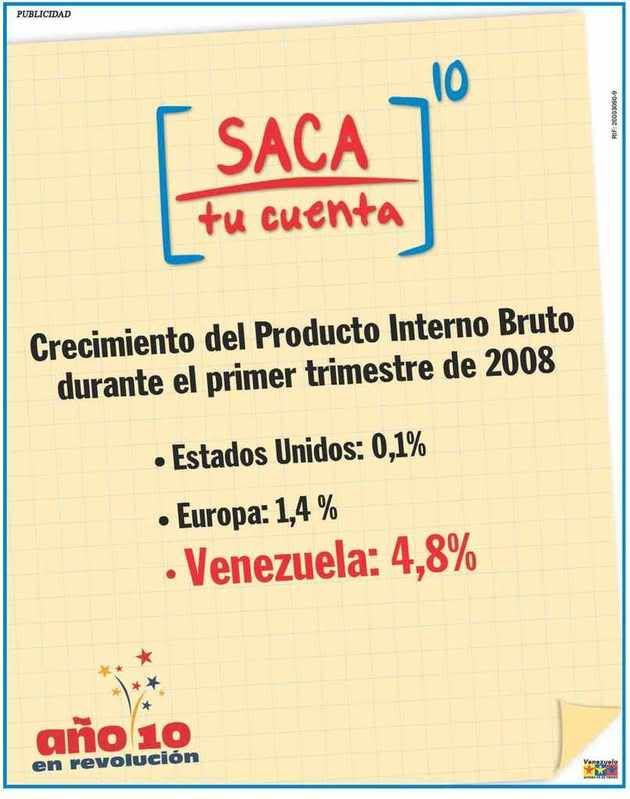
Here the government brags that Venezuela grew 4.8% last quarter while the U.S. only grew .1% and the European Union 1.4%.
Where to begin on this one? Well, lets even ignore the little details like the U.S. is practically in a recession because a real estate bubble just burst whereas Venezuela has record high oil prices that should be propelling its economy forward.
Lets just consider the fact that both Europe and the United States are already developed areas where the great majority of the population has a very high material standard of living whereas in Venezuela most people are, by comparison, poor.
So wouldn't it behoove Venezuela to grow at a very high rate for several decades to try to catch up? And isn't it a little disconcerting that they can't manage to grow at a high rate even with the one thing that dominates their economy going through the roof?
Apparently not to the morons in charge of government propaganda.
Now to the opposition.
Did the example set by the PSUV inspire them to set up their own primaries to choose candidates? No.
Does the fact that the constitution actually REQUIRES primaries make them decide to hold them? No.
But they have come up with an alternative method. When not making back room deals to pick candidates they will be using three pollsters to determine who is most popular and select that person as the candidate.
Cool. Lets just abolish elections and go by opinion polls!!!!
Anyways, what is even funnier about this is who they decided to choose as the polling firms - Ivad, Consultoras 21, and Datanalisis. If you haven't followed Venezuela very closely you might not know this but at least two of those firms, Ivad and Datanalisis, have often been accused of being "Chavista", or incompentant, or overly friendly to the government by virtue of their often releasing polls showing that Chavez is highly popular.
Further, strident opposition pollsters Keller and Associates and Hinterlaces, who often get huge play in the opposition media for their polls showing Chavez is generally unpopular and has declining support, are left out.
In other words, for making propaganda firms like Keller and Hinterlaces are fine, but when the opposition needs results it can depend on it turns to the firms which they have disparaged for years for being "pro-Chavez".
In summary, at least some Chavistas are stupid enough that they believe the government line about the economy being fine and are willing to publish advertisements revealing their stupidity and gullibility.
The opposition on the other hand may lie a lot and make a lot of propaganda but when push comes to shove they aren't so dumb that they actually believe their own propaganda.
Chalk one up for the opposition.
|
Monday, May 08, 2006
Rounding out the polls
Here are the numbers in response to the question "Who would you vote for in this year’s presidential election?
Hugo Chávez 38%
Julio Andrés Borges (PJ) 9%
Manuel Rosales 7%
Teodoro Petkoff 5%
Roberto Smith 1%
Undecided / Would not vote 40%
Certainly this isn't a good showing for the opposition. Even totalling everyone besides Chavez you come up with 38% supporting him against 22% supporting opposition candidates. If the undecided voters wind up voting in the same proportion Chavez would win with 63% of the vote (versus the 58% to 59% he has gotten in all his previous elections).
If this result holds, and with a booming economy, huge social programs, and numerous public works about to come on line it should, there is little doubt Chavez will win. And on a side note it looks like Mr. Teodoro "I can't pay my bills" Petkoff will lose any opposition primary as he is way behind Julio Borges.
So lest there be any doubt, even the most die hard opposition polling firms show Chavez winning easily. About the only question remaining is will the opposition be adult enough to accept their defeat or will they resort to their "fraud" or "we're not playing" routines. Given their continueing inability to mature I suspect the latter.
|
Thursday, February 22, 2007
The opposition eats its own
VENEZUELANS IN FLORIDA
Award to ex-candidate irks Miami's expatriatesAn American political group will give former Venezuelan presidential candidate Manuel Rosales an award in Miami Beach today, and that displeases many of his former local supporters.
Former Venezuelan presidential candidate Manuel Rosales, who once united that country's conflicted opposition, will accept an award today in Miami Beach from a U.S. political organization that hails him as a ``champion of democracy.''
Miami-area Venezuelans who once supported him in his campaign to oust leftist President Hugo Chávez will be far less warm.
''Sincerely, I don't believe he deserves [the award], because he should have fought harder than he did,'' said Nelly Zabala, head of the local campaign team for Rosales' party, Un Nuevo Tiempo. ``Rosales should have answered to his people.''
In the months leading up to the Dec. 3 presidential election, Rosales became the great hope of the long-fractured opposition when the parties put aside their differences to back him as the unity candidate. Despite drawing large, enthusiastic crowds, on Election Day he received less than 40 percent of the votes -- a result that he accepted immediately, despite what many of his supporters maintain were clear signs of fraud.
His quick concession drew fire from the Venezuelan opposition. Nonetheless, his willingness to concede is precisely why the American Association of Political Consultants is giving Rosales the award, said the organization's president, Wayne Johnson.
''Here's a case where someone lost an election in a very volatile situation and who made a commitment to stick with the democratic process,'' Johnson said. ``Rather than only going around and honoring people who win elections, we believe the promotion of the democratic system depends not only on the winners but on the losers.''
Rosales did not respond to repeated requests for comment.
This year's ''Champion of Democracy'' prize, which Rosales will receive at the association's sold-out awards banquet tonight at the Eden Roc Resort in Miami Beach, marks the second time the organization so honors a politician. The previous winner in that category was Ukrainian President Viktor Yushchenko, who fought back against a fraud-plagued 2004 election to eventually win a run-off election against a candidate backed by Russia.
The award to Rosales offends many local Venezuelans, who insist that he should have denounced what they view as irregularities in the voting process -- including cases of local expatriates who tried to vote at the Orange Bowl, but couldn't because their registration location had been changed.
''He betrayed us,'' said Patricia Andrade of the Venezuela Awareness Foundation. ``He was the last hope to remove Chávez democratically, and he killed that opportunity. He sold us out to Chávez.''
The Organization of American States' electoral observers who watched over the balloting in Venezuela said that it was generally trouble-free and that minor problems would not have affected the outcome.
Rosales had planned to meet with the local opposition community, but his representatives canceled the meeting on Friday, citing scheduling conflicts. His proponents-turned-critics say he opted out of the meeting because he didn't want to face expatriates' criticism.
''It's unbelievable to me that he won't come show his face to us, the people who worked for him,'' said Maylin Silva, of All for Venezuela. ``The least he could do is thank us for what we did for him and listen to our concerns.''
All for Venezuela joined with other groups, such as the Venezuela Awareness Foundation, We Are All Venezuela and Independent Venezuelan-American Citizens, to campaign for Rosales, and to organize hundreds of volunteers to work at the local polls on Election Day.
The discontent with Rosales extends through the opposition in Venezuela, said political analyst Oscar Schemel, of the Venezuelan election polling and public opinion firm Hinterlaces.
''People viewed him as a tool to remove Chávez, but he never achieved his own political identity,'' Schemel said. ``The opposition is now feeling resigned, uncertain and pessimistic because they don't perceive any leadership in the opposition to Chávez. They are unhappy with Rosales right now.''
This is truly amazing. Is Rosales the first person to ever lose an election? What was he supposed to do - hold a gun to people's heads so they would vote for him?
All things considered he probably did as well against Chavez as anyone could have. Incumbants coming off of three years of economic boom and sharply higher standards of living simply don't lose - "it's the economy stupid". And why do people like Borges and Petkoff so readily stepped aside? Everyone knew being the opposition candidate would be a thanless task.
So at the end, Rosales couldn't walk on water and lost to Chavez as any mortal would have. And for this "crime" he is not pilloried amongst the opposition. The indecency and disrespectfullness of this is breathtaking.
I know there are many decent people amongst the Venezuelan opposition. But it is also very apparent there is a great collection of very juvenile behavior amongst its middle aged supporters too.
And by the way, Rosales should be proud of this award. He did a great thing last December 4th by being adult enough to accept results once it was clear they were accurate and by getting his supporters to do the same. I may not agree with his politics but that does make him a patriot in my eyes. And even though I thought his attempt to out populist Chavez in his campaign was a mistake this sad spectacle shows that in reality much of the opposition was underserving of someone of his caliber.
|
Monday, November 12, 2007
If they would stop throwing rocks long enough to campaign...
I wouldn't say Keller is the most reliable firm - both they the other hard line polling firm Hinterlaces have always struck me as bending over backwards to give the most favorable scenario for the opposition. But even if they do looking at their numbers can be interesting, keeping in mind that they are probably the most favorable numbers for the opposition that exist. [Apologies in advance for the poor quality of the slides - if you want to see better copies go to the actual presentation]
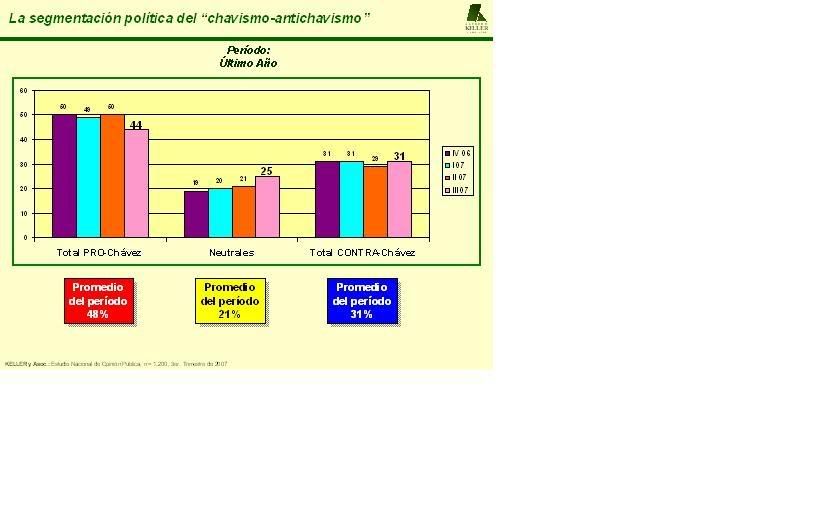
This slide shows how support for Chavez, the opposition, and neither have trended over the past year. Chavez of course has been consistently ahead. However, according to this his support slid some in this past quarter.
What happened in the past quarter that would make his support slide I don't know. The controversial RCTV shutdown happened in the second quarter for example.
What is also interesting to note is that the slight decline support for Chavez hasn't translated into higher support for the opposition. Instead, the group that increased were the "nuetrals" who support niether the opposition nor Chavez.
In other words maybe Chavez's hubris has turned some people off lately. Yet they look at the rock throwing opposition and blanch. So they choose niether. Makes sense.
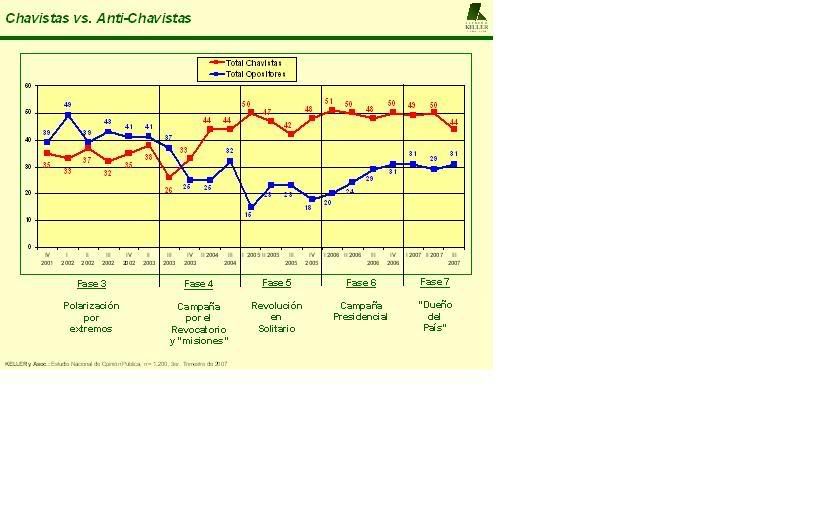
This slide shows Chavez's support in relation to the support of the opposition over the last 5 years. Predictably Chavez is red, the opposition blue.
And as we know although Chavez may have been unpopular (barely) in 2002 the opposition self destructed with its coup attempts and oil strikes allowing Chavez to once again assume the lead, which he has never relinquished.
Interestingly the opposition has managed to recover its support somewhat over the past couple of years. I suspect that results from people's memories of the coup and oil strike fading. Also, the maturity the opposition showed in finally accepting an electoral defeat probably boosted their stature in some peoples eyes.
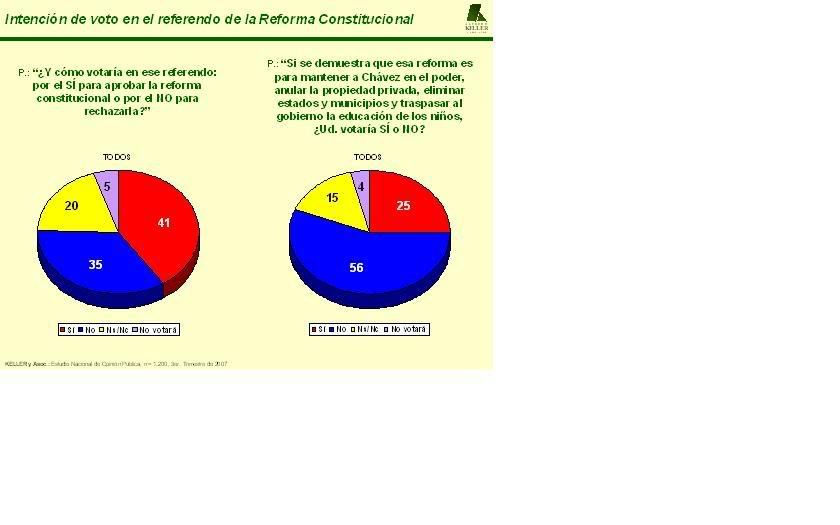
Finally, we get to what people think about the proposed reforms. On the left we see how people would vote if the vote were today with 41% saying they would vote for it to 35% saying they would vote against it. That is only a 6% margin - not all that much, especially for a constitutional reform which at least in theory you would like to see more of a mandate for. Further, a full 20% are still undecided meaning even without changing the minds of any of the people currently in favor of it the NO option can still win.
On the right, you see sample of what most of the rest of the poll is like - asking people hopelessly loaded and leading questions. The one in this case asks "If it was shown that this reform was only to keep Chavez in power, eliminate private property, eliminate states and munincipal governments, and hand the education of childrend over to the government would you vote yes or no".
Jeez, I wonder if Gallup will go around asking people in the U.S. "Who will you vote for Hillary Clinton, who will provide health care for all, or Rudy Guiliani, who will likely start a war with the entire muslim world". If such questions are of interest to you again feel free to check out the whole presentation.
Summing up, it is clear Chavez is still popular, significantly more popular than his opponents. It appears that that popularity will allow these reforms to pass.
However it is also clear that victory is still up for grabs and that for the first time in years the opposition has a fighting chance to win an actual vote. Of course, they would have to run an organized, well thought out, principled, and inclusive campiagn - not something they've been noted for in the past. Still there is hope for them and hope for all of us who think these proposals should be defeated.
Still, there is little margin for error on the part of the "NO" campaign. And doing stupid things like throwing rocks at people and setting buildings on fire isn't going to get it done.
So to our opposition friends, put down the rocks, leave the hatred aside, and speak to people. You can win but you have to do three things - persuade, persuade and persuade.
Do you have it in you to talk and persuade, or only to throw rocks and hate? What happens on December 2nd will likely turn on the answer to that question.
|
Wednesday, November 15, 2006
Poll wars
So what is a poor opposition supporter supposed to do? Simple. Invent their own polling firm. And that is exactly what they did. Not only that, but they had the new, never heard of before firm, take out a full page ad in Ultimas Noticias trumpeting their results:
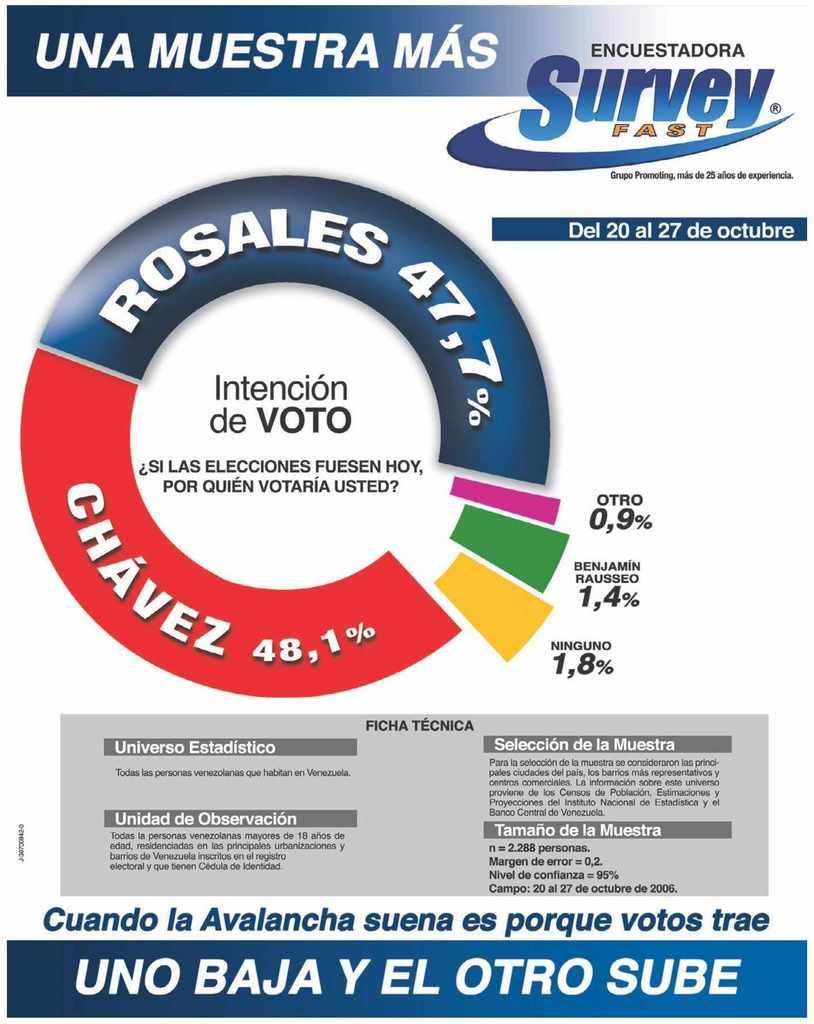
This isn't the first time they've done this. I've seen these ads on the results of unkown firms before. But they seem to be stepping it up a notch now. Desperation time I guess.
|
Saturday, November 11, 2006
Callling the bluff on the polling numbers poker game.
Soooo, to humor all the opposition types who frequent this blog can any of you provide a link to a poll showing Rosales been essentially even to Chavez or even getting close (hell, I'll take one even showing him getting within ten points)? Three conditions: it has to be a poll by a known polling firm (eg, Datanalisis, Keller, Datos, Sejias, Hinterlaces, Consultores 21, etc) and it has to have been published in a known newspaper (i.e. links to unsubstantiated Noticiero Digital articles don't count), and it has to actually ask people who they would vote for. I think those are pretty straighfoward conditions easily met by any REAL poll.
All the polls I have seen, and blogged on, show Chavez with a clear and consistent lead of between 15 and 20 percentage points. But if our opposition friends can show a poll that says otherwise the comment section is all yours. Put your cards on the table and show us the numbers. We're waiting....
|
Thursday, September 21, 2006
Someone would seem to be BSing the polls
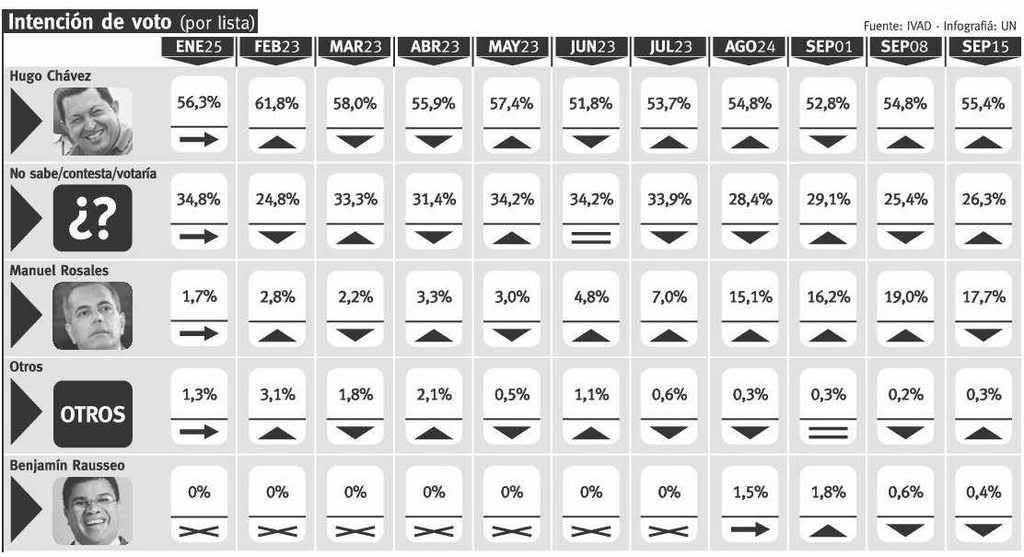
In the past week an American polling firm, Penn & Schoen, came out with a poll purporting to show that Rosales was within 15% of Chavez. The problem is, that same polling firm was involved in some very contraversial exit polls during the Referendum on Chavez two years ago that turned out to almost certainly not be true.
Then a Venezuelan polling firm, Hinterlaces, came out with a poll showing Chavez declining below 50% and Rosales in the 30% range. That seemed plausible but odd given that other recent polls have shown Chavez with a huge lead and Rosales never even cracking 20%. One of those polls was by the large Venezuelan polling firm Datos. Today they came out with an even more recent poll showing that not only had Chavez not declined in support but he actually increased his support ever so slightly while Rosales continues to trail very badly. So something does appear to be afoot here.
|
Friday, April 28, 2006
Stepping the propoganda up a notch
"Mr. Chavez will seek another six-year term at an election in December. The government wants to shift the political debate away from bread and butter issues. So Mr. Chavez is claiming that what is at stake in the election is an ideological conflict between teh United States and Venezuela's "Bolivarian Revolution" and that his true opponent will be George Bush. Earlier this month police stood by as a crowd of Chavistas, some on motorbikes, pelted the American ambassador's car with eggs after he donated baseball equipment to a school in a poor area of Caracas.
Such ciruses may not deflect the grievances of ordinary Venezuelans. In the past two months there have been at least 30 demonstrations demanding that the government fulfil its promises in matters such as housing and jobs. Mostly leaderless, the protests mix chavistas and non-chavistas, although most of the latter do not support the opposition. The governments approval rating was only 14% in a recent survey by Hinterlaces, a polling firm"
There are a couple real pearls in there. First Chavez would run away from "bread and butter" issues? Is this their idea of a joke. The economy has grown 17% and then 9% in the past two years. It could well wind up growing another 8 or 9% this year. Unemployment has fallen from over 20% in early 2003 to just 10% now. Inflation is down, income is up, social programs are expanding, and between now and December Chavez will be hard pressed to find time to inaugerate all the new public works his government is finishing. Under those circumstances we are supposed to believe that Chavez would be running way from "bread and butter" issues?!?! With that kind of non-sense they are risking their reputation as a serious periodical. Or maybe they just never hear the famous expression from James Carville "Its the economy stupid!".
But it gets even better. They then claim that the government only has 14% support according to an opinion poll. Never mind that the polls consitantly shows Chavez with an approval rating of around 70% and I've never seen one in the past year that put him below 50%, much less 14%!! At the very least they would seem to be trying to mislead here. Could it be they asked some question about some part of the "government" and got 14% (maybe Venezuela's Department of Motor Vehicles polls at 14%?) but we don't know because they don't say. But it would appear they hope the casual reader will think "Golly, 14%, Chavez is really unpopular, no wonder people are talking about him being a dictator." Yet, in reality Chavez is very popular and will almost certainly win any freely contested election.
As bad as this was, there is even worse and in periodicals that would claim to be even more serious and academic. Stay tuned.
|
Monday, October 03, 2005
Chavez still has their hearts
The Power Point presentation first gives some updated polling numbers. And what do they show? That Chavez is supported by 59% of the population and opposed by 41%. This is almost exactly the same margin he won by in last years referendum and more or less in line with all the other polls that have shown his support oscillating between 60 and 80 percent. And these numbers are further broken down. Of the 59% who support Chavez 30% are strong supporters while 29% are moderate supporters. Of the 41% who support the opposition 15% are strong supporters while 26% are moderate supporters. So there are twice as many strong Chavez supporters as there are strong opposition supporters. Certainly not much in these numbers to hearten the opposition.
Then we get to what the opposition has wound up focusing on – the supposed intention of only 45% of those polled to vote for Chavez. This appears on slide 19 of the presentation which is entitled “The ‘popularities’ of Chavez”. This slide gives what it says are four different indicators of Chavez’s popularity.
The first is just his plain “popularity” which it defines as the level of liking or approving of him. This number is 61%. Why is it different from the 59% given a few slides before – got me. Escualido math I guess. It then gives a couple other results on who people would prefer win the next election (49%) or how many people want an alternative to Chavez to arise (45%).
But the final number it gives is what the opposition has been trying to emphasize. It asks peoples intention to vote “if the elections were to be held right now” and gives a result of 45%. Now what the some in the opposition have been grasping at is interpreting this number to mean only 45% of those polled would vote for Chavez right now. While its possible that is what that number means it really isn’t at all clear. They don’t give the actual question asked and it may well be that people were simply stating whether or not they intend to vote – not necessarily whether they will vote for Chavez. What is more, they don’t ask how many would vote for any potential opponent of Chavez. So if the opposition thinks Chavez is vulnerable based on just these numbers they are indeed grasping at straws.
So some ambiguities not withstanding the Keller poll shows that Chavez still enjoys the support of a large majority of Venezuelans and would almost certainly easily win any electoral contest. I think he’ll take that any day.
|
Wednesday, September 28, 2005
Polling numbers
It then goes on to say that the popularity of Chavez himself has gone down from 53% to 45%, both of which are significantly lower than any other numbers I have seen for him. However, it then says that the so-called “Ni-Ni”, those who are against both Chavez and the opposition is now 53%. So if you add the 53% opposing both Chavez and the opposition to the 45% supporting Chavez you wind up with 98% of the population thereby implying that somehow only 2% of the population supports the opposition!!!! Rather bizarre.
Obviously that can’t be correct yet that is the way the poll numbers read. As usual they don’t give any technical data or what the questions were they posed to people. Plus they don’t indicate if they asked people if they approve of the opposition and how many said yes. Its reasonable to assume they probably did ask that question and its probably not a bad guess to say that the reason they didn’t publish it is because the numbers weren’t very good. The other bizarre, although not entirely impossible, part of the poll is the large discrepancy in the approval numbers between Chavez and the Missions especially considering how closely he is identified with them.
In any event, you can see some of the reading between the lines that gets done with what passes for polls in Venezuela. However, as the legislative elections are only two months away polls, good and bad, are going to be important to pay attention to.
|